
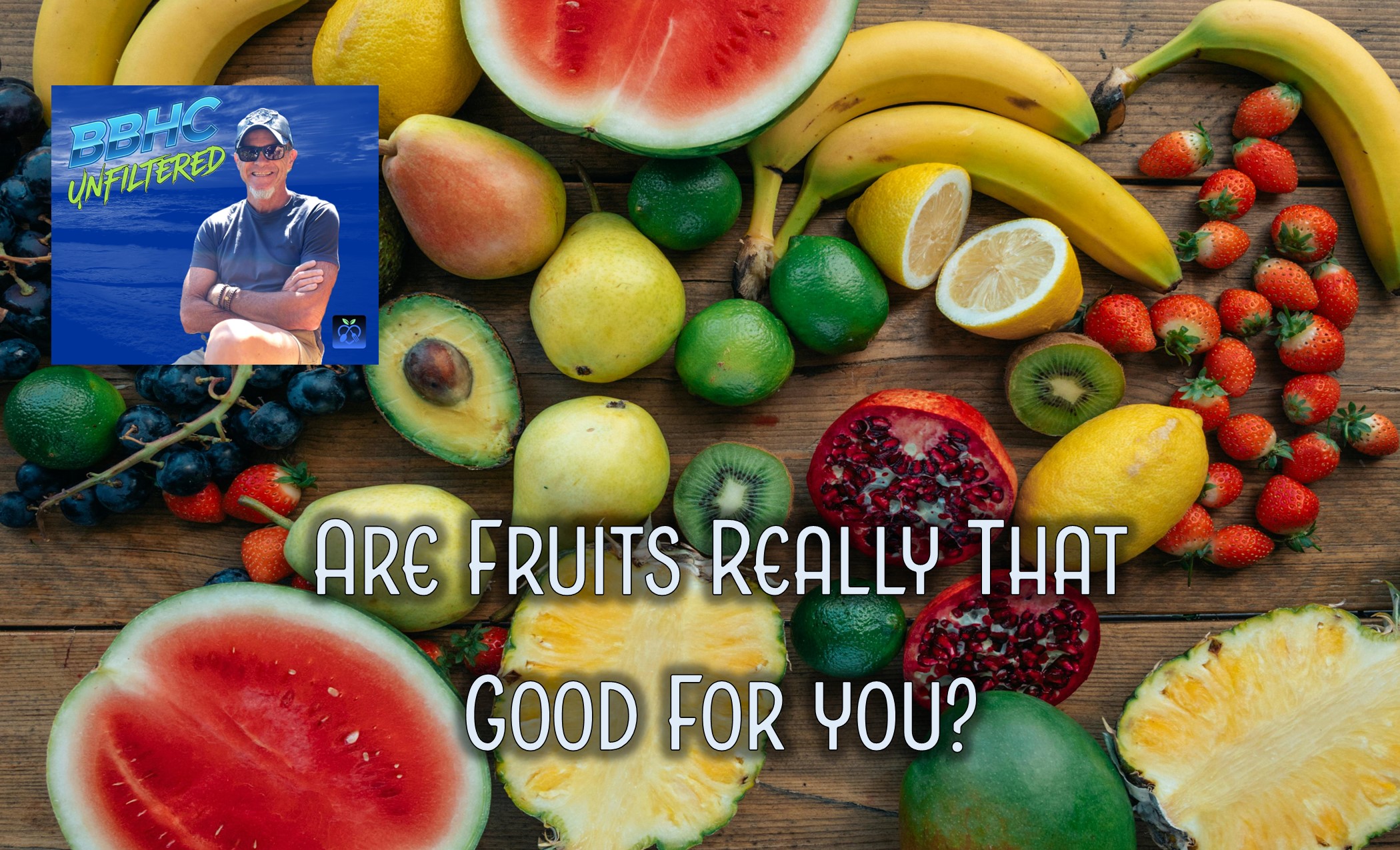
The Fruit Illusion: Why Not All “Healthy Foods” Are Created Equal
For decades, we’ve been handed a neat, comforting idea: eat more fruit and vegetables. They’ve been bundled together as if they’re nutritionally identical, as if swapping broccoli for a banana is simply a matter of preference. It sounds tidy. It sounds logical. It just doesn’t hold up under scrutiny.
At BBHC, the approach is simple—strip away the noise and look at what the body actually does with what you eat.
When you do that, the distinction between fruit and vegetables becomes impossible to ignore. Vegetables are low in sugar, rich in fiber, and packed with micronutrients that support stable energy, digestion, and metabolic balance. Fruit, on the other hand, carries a very different profile. It contains significantly higher levels of sugar—particularly fructose—and that changes everything.
Fructose is not handled like other sugars. While glucose can be used by nearly every cell in the body, fructose is processed almost entirely in the liver. That means every piece of fruit you eat places a metabolic demand on a single organ already responsible for managing toxins, hormones, and energy regulation. When intake is modest, the system copes. When it’s excessive—as it often becomes in modern diets—the consequences start to show.
Fat begins to accumulate in the liver. Insulin sensitivity starts to decline. The slow drift toward metabolic dysfunction begins, often without obvious warning signs.
This is where things get quietly problematic. Fruit carries a health halo. People don’t question it. They don’t measure it. They certainly don’t limit it. And yet, from a biochemical standpoint, large amounts of fructose—whether from processed sugar or “natural” sources—place the body under the same kind of strain.
There’s another layer to this, and it’s one most people never consider: appetite regulation.
Fructose does a poor job of signaling fullness. Unlike glucose, it doesn’t effectively suppress the hunger hormone ghrelin. So you can eat fruit, feel like you’ve made a healthy choice, and still find yourself hungry not long after. That subtle disconnect leads to increased calorie intake over time, and eventually, weight gain follows.
It’s not a failure of willpower. It’s physiology doing exactly what it was designed to do.
Then there’s the hormonal response. High fructose intake can elevate cortisol levels, which in turn influences insulin. As cortisol rises, insulin demand increases, and sensitivity decreases. Over time, this creates the perfect environment for fat storage, energy crashes, and the long-term development of metabolic conditions like type 2 diabetes.
Now step back and compare that to vegetables.
Vegetables provide many of the same vitamins and phytonutrients, but without the sugar burden. They support gut health, stabilize blood sugar, and deliver nutrients in a form that works with the body rather than against it. They don’t overload the liver, they don’t disrupt hunger signals, and they don’t create the same hormonal ripple effects.
They simply do their job—quietly and efficiently.
Another point that tends to get overlooked is nutrient completeness. While fruit is often praised for vitamin C and antioxidants, it falls short in several critical areas. It contains minimal protein, virtually no healthy fats, and lacks key nutrients such as iron, zinc, B vitamins, omega-3 fatty acids, and vitamin D. Relying heavily on fruit as a nutritional cornerstone is like building a house with only half the materials—you might get something standing, but it won’t be structurally sound.
This doesn’t mean fruit is the enemy. It means it needs to be understood.
Lower-sugar options like berries can be included more comfortably, offering fiber and beneficial compounds without overwhelming the system. Higher-sugar fruits, however, need to be approached with awareness. Not fear—just awareness. Because the difference between helpful and harmful often comes down to quantity and frequency.
And here’s where the modern diet has drifted far from its roots. Historically, fruit was seasonal, less sweet, and far less available. Today, it’s engineered for sugar content, available year-round, and consumed in volumes that our physiology simply wasn’t designed to handle.
The body hasn’t changed. The environment has.
At BBHC, the priority is clear: build your nutrition around what supports stable energy, balanced hormones, and long-term metabolic health. Vegetables form the foundation. They provide density without disruption. Fruit, when used, becomes a complement—not the main act.
Because at the end of the day, your body doesn’t respond to marketing claims or outdated dietary slogans. It responds to chemistry.
And chemistry, unlike opinion, doesn’t negotiate.