
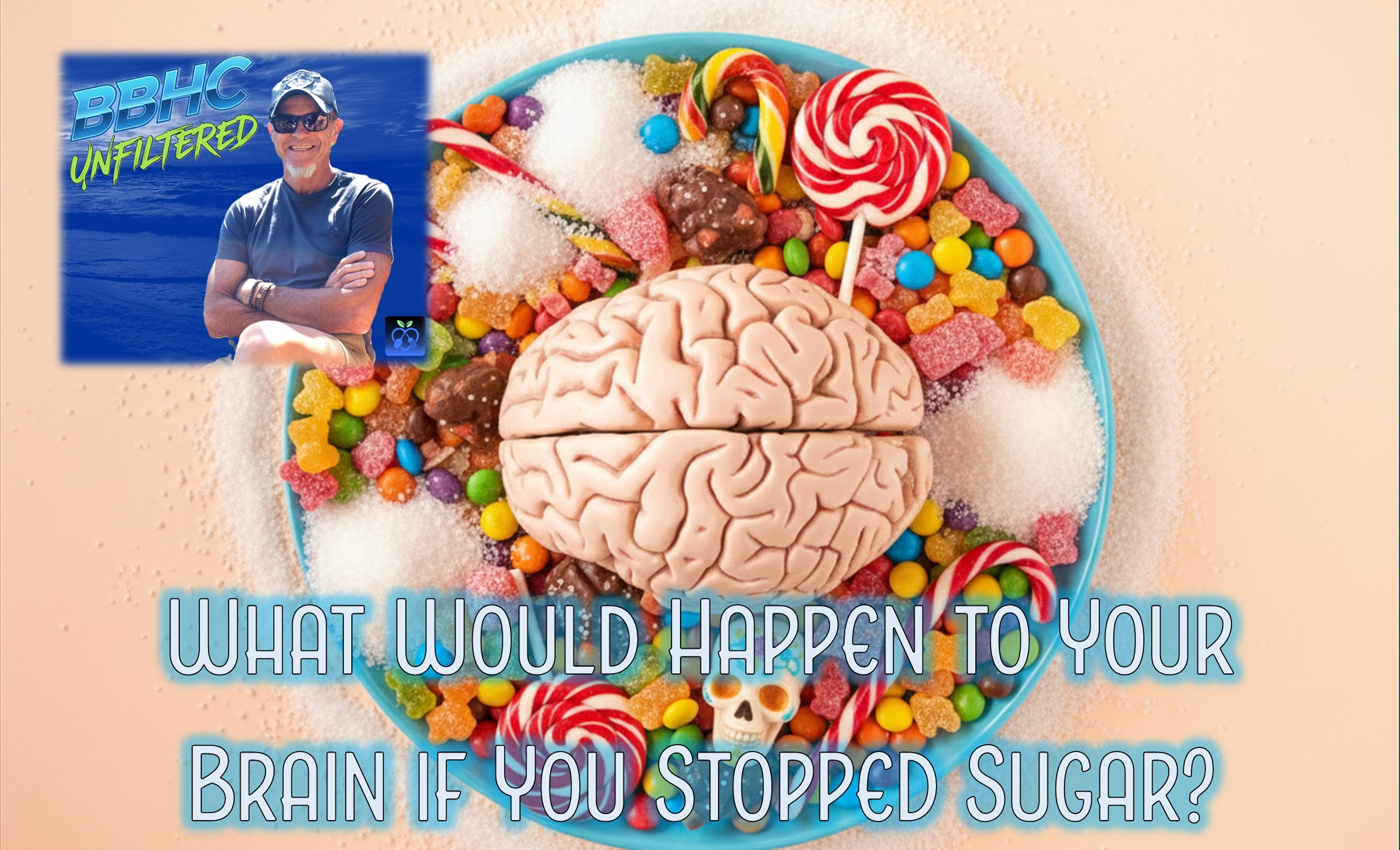
No Sugar for 3 weeks: What Happens to Your Brain (And Why Skipping Breakfast Makes It Easier)
If you removed sugar for 21 days—three weeks—your brain would not just “feel a bit better.”
It would change.
Not in a motivational-poster way. In a measurable, physiological way: blood flow, brain growth signals, mood chemistry, attention, sleep, and resilience under stress.
The most interesting part? This isn’t “willpower magic.” It’s a fuel switch—from sugar dependence to ketone-powered stability.
And at BBHC, we use one foundational lever to make this switch easier and faster:
Skipping breakfast (strategically, not masochistically).
Let’s unpack what happens.
The 3 week Brain Upgrade: Blood Flow and Brain Growth
A research paper discussed in the transcript (Journal of Clinical Endocrinology & Metabolism) looked at a ketogenic-style approach for three weeks and found something eye-opening:
Brain blood flow increased by 22%
BDNF (Brain-Derived Neurotrophic Factor) increased by 47%
That’s not a rounding error.
A 22% boost in blood flow means more oxygen and nutrient delivery to your brain—like someone quietly upgraded your “brain plumbing.”
Then there’s BDNF: a protein that signals the brain to repair, grow, rewire, and form new connections. It’s often described as supportive for mood and cognitive function—an “anti-depression” type molecule.
In plain English: three weeks without sugar can push your brain toward better performance and better stability.
What Sugar Does to the Brain (And Why It Feels Like You’re Losing Your Mind)
Most people know sugar causes a blood sugar spike, then a crash.
But the brain consequences are brutal and very predictable:
Brain fog
Irritability
Anxiety
Poor focus
Weak memory
Mood swings
Bad sleep
“Hungry” again 90 minutes after eating
That last one is the giveaway.
If you’re hungry 90 minutes after eating, that isn’t real hunger. It’s a fuel crash. Your brain is reacting to unstable glucose.
The deeper issue is this: when the brain is repeatedly flooded with sugar, it begins to resist it. That’s insulin resistance—your cells block the incoming fuel to protect themselves.
So you end up in a ridiculous situation:
You have fuel in the blood
But the brain cells can’t access it properly
So you feel tired, foggy, moody, and wired-but-exhausted
That’s not a character flaw. That’s biochemistry.
The Hidden Problem Nobody Connects: Sugar and Vitamin B1 (Thiamine)
The transcript highlights a key point that explains a lot of “random” symptoms:
High carbohydrate intake can drive up the demand for Vitamin B1 (thiamine).
Think of B1 like a spark plug. You can pour fuel into an engine all day, but if the spark plug fails, you don’t get usable power.
Without enough B1, you struggle to generate energy efficiently (ATP production suffers), and the nervous system—one of the most energy-demanding systems in the body—starts malfunctioning first.
That’s why B1-related issues can look scattered and unrelated:
Anxiety, nervous tension, racing thoughts
Poor stress tolerance, short fuse
Dizziness / lightheadedness when standing
Palpitations or heartbeat irregularities
Dry eyes, dry skin
Air hunger (can’t get a satisfying breath)
Constipation, bloating, weak digestion
Poor bile output (harder fat digestion)
Blurred vision
Restless legs at night
Early morning insomnia / low REM sleep
People treat these as separate problems. Often they’re downstream effects of the same pattern:
too much sugar + constant snacking + nervous system depletion.
Why BBHC Pushes “Skip Breakfast” for Sugar Detox
Cutting sugar is hard when you keep stoking the fire.
Breakfast is often where sugar dependence gets reinforced:
cereal
toast
oats
fruit juice
“healthy” granola bars
sweetened yogurt
hidden starches
Even when people “eat clean,” breakfast is frequently high-carb by default.
At BBHC, skipping breakfast works because it:
reduces early-day insulin spikes
interrupts the snack-crash-snack loop
accelerates the shift toward ketones
makes cravings easier to manage
restores true hunger signals
Here’s the blunt truth:
If you start the day with sugar or starch, you’re signing up for cravings and mood swings later.
If you delay the first meal and keep it protein-and-fat based, your brain gets a stable fuel environment—and sugar loses its grip.
Week-by-Week: What You’ll Notice When You Quit Sugar
Week 1: The Transition
Expect some friction:
cravings
irritability
headaches (often electrolytes)
“where is my reward?” brain signals
This is the dependence loop breaking.
Support makes it easier:
electrolytes (especially if going low carb)
whole-food meals
adequate protein
cutting liquid sugar completely
Week 2: Energy Comes Back
This is where people get surprised:
steadier mood
better sleep
less bloating
more consistent energy
reduced brain fog
Week 3: Mental Clarity and Calm Become the New Normal
Now the benefits stack:
sharper focus
lower anxiety
fewer cravings
better mood consistency
easier time going meal-to-meal
appetite drops naturally
This is the point where many people realise:
“I wasn’t lazy. I was running on unstable fuel.”
“But Isn’t Glucose the Primary Fuel?”
No.
Your body can use glucose, but it’s not the only strategy—and historically it wasn’t reliably available.
Humans survived long stretches with limited carbs, and the brain had to run on something.
That something is ketones—a cleaner, more stable fuel source produced from fat.
This is why fat storage exists: it’s not just padding. It’s a survival energy reserve.
The modern world flipped the script:
constant sugar → constant insulin → constant cravings → constant snacking
Your brain wasn’t built for that.
How to Do 21 Days No Sugar (BBHC-Aligned)
Key targets:
Keep total carbs under ~50g/day
Avoid sugar and industrial starch (corn starch, “modified food starch,” maltodextrin, wheat flour)
No soda, no juice, no “healthy” sweet drinks
Build meals around:
quality meat, eggs, fish
non-starchy vegetables
healthy fats (butter, avocado, olive oil)
full-fat, unsweetened dairy (if tolerated): yogurt/kefir/cheese
nuts (in moderation)
And the BBHC lever:
Skip breakfast if you’re not truly hungry
Break your fast with a solid protein-and-fat meal
No “carb-first” starts
In a Nutshell
Three weeks without sugar can:
improve brain blood flow
increase BDNF (brain repair and growth signaling)
reduce brain fog
stabilize mood
improve sleep
restore calm focus
reduce cravings dramatically
And skipping breakfast—done properly—can make the whole process easier by cutting off the daily sugar-trigger cycle at the source.
Your brain doesn’t need sugar.
It needs stable fuel and a break from the rollercoaster.