
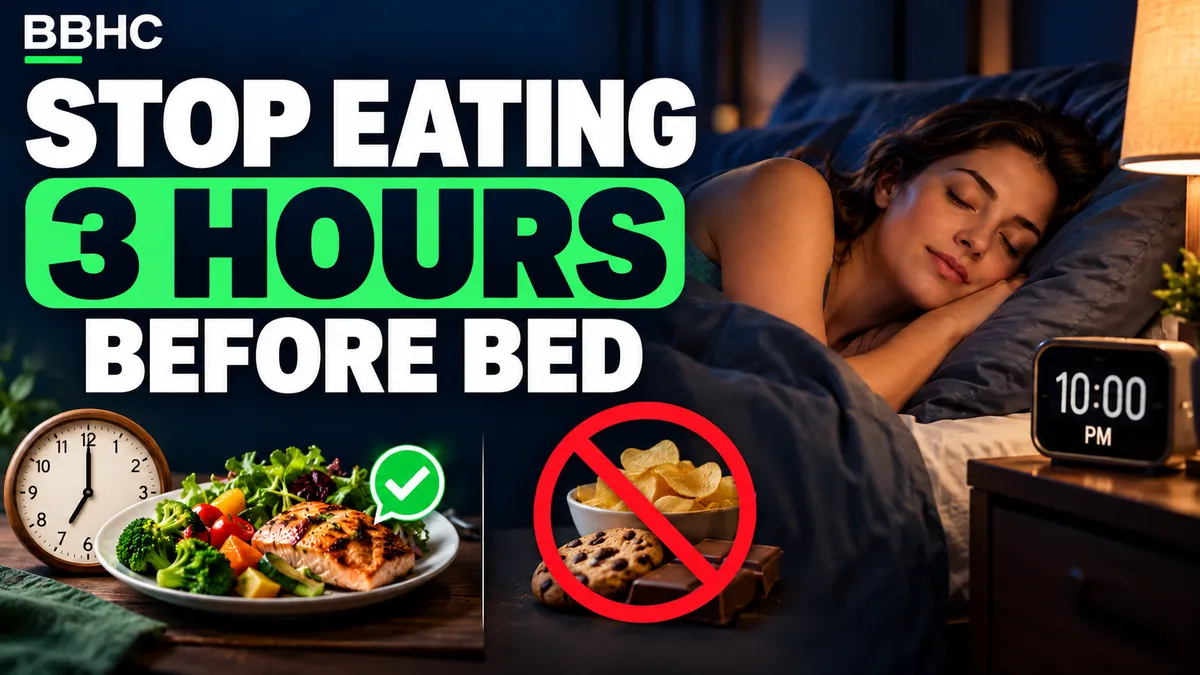
Why the Timing of Your Last Meal Matters
Eating before bed is about more than an extra snack. The transcript explored in this article connects evening eating with insulin, growth hormone, deep sleep, and the body’s overnight repair processes.
From a BBHC coaching standpoint, the central habit discussed is straightforward: plan your last meal around your bedtime, with a three-hour gap between finishing your meal and going to sleep. Understanding the explanation behind that habit makes it easier to see why the timing—and the contents—of your evening meal matter.
Growth hormone and the first 90 minutes of sleep
The video describes the first 90 minutes after falling asleep as the period when the body releases its largest growth hormone surge of the day. This release occurs mainly during deep, delta-wave sleep.
Growth hormone comes from the pituitary gland, a small gland in the brain. The transcript states that a snack before bed can suppress this hormonal event by as much as 78%.
The timing is linked to falling asleep rather than a fixed hour on the clock. If you go to sleep at midnight, the relevant period begins after midnight. This is why the speaker challenges general rules such as “never eat after 6 p.m.” or “never eat after 8 p.m.”
He illustrates the difference with his own household: he goes to bed at 10 p.m., while his wife goes to bed at 9 p.m. Their evening meal cut-off times would therefore differ.
The three-hour gap is counted backwards from your own bedtime, with particular emphasis on avoiding sugary food during that period.
Why insulin is central to the discussion
The concern about sugar centres on the hormone it activates: insulin.
According to the transcript, insulin strongly suppresses growth hormone. This matters because growth hormone is involved in several functions:
Burning fat.
Building muscle.
Repairing skin and collagen, which forms part of connective tissue.
Supporting bone growth.
Supporting recovery, particularly after exercise.
The video therefore presents growth hormone as more than a fat-burning hormone. It is also part of the body’s building and repair system.
Exercise places stress on muscles and breaks them down. The transcript explains that much of the rebuilding and benefit from that exercise occurs during sleep, provided that sleep takes place and insulin is not excessively elevated.
This is also the explanation behind the speaker’s reference to “beauty sleep”: overnight repair involves the skin and connective tissues as well as muscles.
The video further describes growth hormone as acting on the immune system and neurons, or nerve cells. It states that growth hormone helps build grey matter in situations involving brain damage.
Does this mean you can never eat after dinner?
The transcript makes a distinction between eating itself and eating foods that strongly stimulate insulin.
Although its overall recommendation is to finish eating three hours before bed, the speaker clarifies that his main concern is the insulin response. Foods that trigger insulin are described as blunting growth hormone.
He says protein does not stimulate insulin very much and that vegetables also have a relatively small effect. Sugary meals and starches are identified as the main sources of the larger insulin response discussed in the video.
The speaker also acknowledges how firmly evening snacking can become established. He describes previously eating continually after dinner until bedtime. While working at a theatre, he would bring home a garbage bag of salty popcorn for himself and his father to eat.
The example illustrates how late eating can become a nightly routine rather than a response to genuine hunger.
Deep sleep and how you feel the next morning
Deep sleep is another central part of the discussion.
The transcript explains that deep sleep helps you wake feeling refreshed. Without enough of it, you may wake groggy, experience poorer thinking and concentration, and start craving unsuitable foods.
It also states that insulin can affect deep, delta-wave sleep. In the video’s explanation, evening eating can therefore influence both the hormonal repair process and the quality of sleep itself.
The speaker compares the body’s internal environment to a fish tank. If the water is polluted, the fish becomes sick. Feeding it the best food or treating individual symptoms does not resolve the underlying problem while the water remains unsuitable.
He describes the body as operating through ten main signals, naming insulin, cortisol, inflammation, sleep quality, and gut function as examples. Each affects how a person feels. His argument is that one signal may be more disrupted than the others, keeping progress stalled until it is addressed.
The video includes an invitation to take a free, two-minute quiz intended to identify which main signal is holding someone back. Viewers are directed to a link in the video description.
Fasting and growth hormone
The transcript describes fasting as another influence on growth hormone.
It states that 24 hours of fasting can potentially increase growth hormone fivefold when a person goes to sleep that night.
The spoken transcript then uses the phrase “spike insulin” while continuing this discussion of fasting and growth hormone. Elsewhere in the same passage, it describes low insulin as helping growth hormone function normally.
For prolonged fasting, the video states that a five-day fast doubles the pulse frequency of the growth hormone surge, describing this as two spikes instead of one.
These are the fasting-related effects presented in the transcript.
Exercise intensity and growth hormone
The video also identifies high-intensity interval training as a way of increasing growth hormone.
Weightlifting and other activities that activate the muscles are included in this discussion. The speaker states that greater exercise intensity produces a larger growth hormone spike.
He particularly highlights explosive sprinting and plyometric exercise—movements involving explosive muscular effort—as exercises he considers especially effective for this purpose.
The relationship presented is that exercise provides the stimulus, while sleep provides an important opportunity for recovery and rebuilding.
Melatonin, darkness, and late meals
Melatonin adds another part to the explanation.
The transcript describes melatonin as a hormone activated by darkness that helps you fall asleep. It also states that melatonin helps the pancreas release less insulin.
According to the video, late eating and the resulting insulin response can affect melatonin. A sugary evening meal may therefore make it more difficult to fall asleep.
The discussion brings together three connected elements: darkness and melatonin, food and insulin, and sleep-related growth hormone release.
How common is evening snacking?
The video gives several figures to show that evening snacking is widespread:
60% of adults snack at 8 p.m.
44% of people eat in bed at night while watching television.
58% of people aged 18–24 snack regularly.
It also refers to a Harvard study that, according to the speaker, found people are hardwired to become hungry around 8 p.m.
His point is that a tendency towards evening hunger does not mean the habit cannot be changed.
One practical suggestion is to place a magnetic sign on the refrigerator saying “The kitchen is closed.” If dinner ends at 7 p.m., that sign becomes a visible reminder that eating has finished for the day.
Salt cravings and the suggestions in the video
The transcript distinguishes genuine hunger from a craving for salty, crunchy foods.
The speaker argues that some people with these cravings need more salt. He describes previously consuming little salt during the middle of the day and then wanting it towards the evening.
His proposed approach is to consume salt earlier in the day. He states that an average person needs almost a teaspoon of sea salt daily and suggests adding it to the first meal. He also suggests including it with electrolyte powder earlier in the day to “preload” sodium.
The video links low sodium with cravings for salty snacks and greater difficulty falling asleep. Its explanation is that sodium helps reduce cortisol, making it easier to drift off.
For an evening salt craving, the speaker suggests a little salt with water instead of salty, crunchy food. He describes either mixing the salt with water or putting a little in the mouth and drinking water afterwards. He reports sleeping better when his salt craving is satisfied.
The video also addresses blood pressure concerns. The speaker attributes these to low potassium and suggests a high-potassium electrolyte powder during the day. He recommends daytime use rather than use before bed because, in his explanation, it pushes out fluid. He then suggests that additional sea salt could be taken at night.
These are the sodium and potassium suggestions made in the supplied transcript.
Reducing sugar and changes in fluid retention
The video states that people accustomed to consuming substantial amounts of sugar may retain fluid.
When sugary meals are removed, the speaker says urination may increase while that excess fluid is lost. He explains this by stating that carbohydrates retain sodium and fluid, and describes the increased urination as temporary while the excess fluid clears.
This is presented as another change someone may notice when altering an established evening eating pattern.
Set your last meal according to your bedtime
The main routine described in the video is to subtract three hours from the time you intend to go to sleep.
For example:
Bedtime | Last meal finishes |
|---|---|
9 p.m. | 6 p.m. |
10 p.m. | 7 p.m. |
Midnight | 9 p.m. |
The last meal should be nutrient-dense and sufficiently satisfying. The transcript emphasises adequate nutrients, fat, protein, and salt so that genuine hunger does not return later in the evening.
It also distinguishes hunger from eating because of boredom or stress. A satisfying final meal addresses hunger; closing the kitchen provides a clear boundary for the habitual snacking that follows.
For BBHC, the practical habit explored here is a well-planned final meal followed by a three-hour period before sleep. The video presents this as a simple change with substantial potential benefits for the processes it discusses: sleep, growth hormone release, overnight repair, and recovery.
The speaker closes by emphasising the importance of understanding the details of intermittent fasting and directs viewers to a separate video explaining how to approach it.