
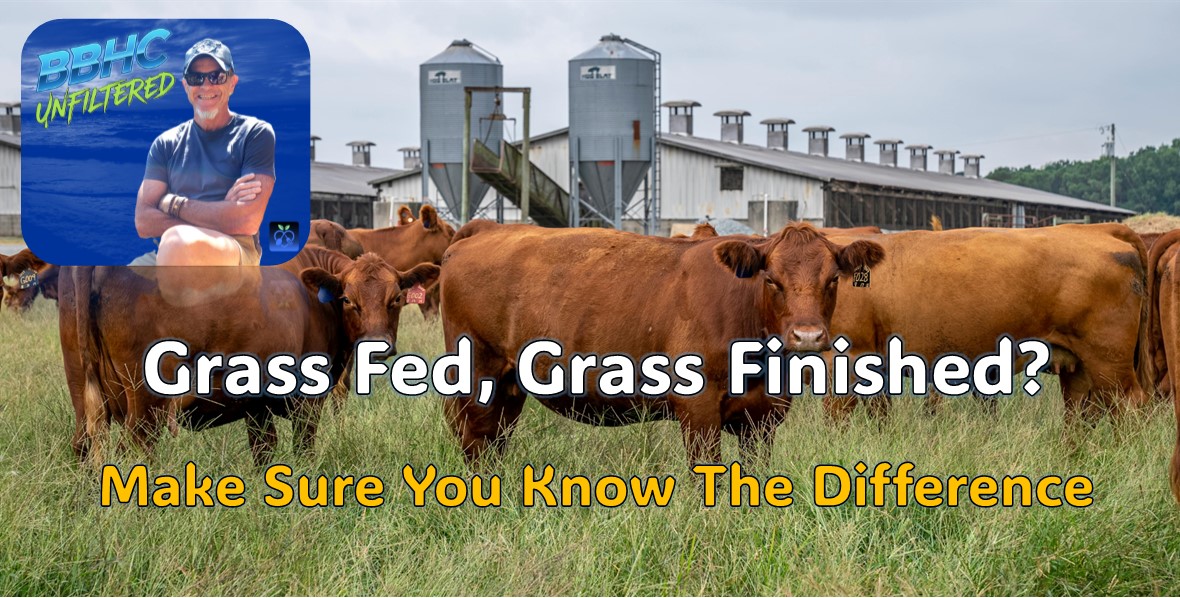
The Truth About “Grass-Fed” Beef: Why Most of What You’re Buying Isn’t What You Think
Most people believe they’re making a healthy choice when they buy “grass-fed” beef. The label sounds clean, natural, ancestral—exactly what real food should be.
Here’s the uncomfortable truth: the vast majority of beef sold under that label does not match the picture in your head.
This isn’t a conspiracy theory. It’s a labeling loophole problem—and it has real consequences for your health.
“Grass-Fed” Doesn’t Mean What You Think It Means
All cows eat grass at some point in their lives. That single fact is the loophole.
In modern beef production, many cattle spend the final 3–6 months of their lives in feedlots, being fattened rapidly on non-grass feeds. Yet the meat can still be sold using “grass-fed” language.
The result?
Beef that started on grass but was finished on something very different—while the label tells a much friendlier story.
Unless it clearly states “100% grass-fed”, the term alone means very little.
The Country-of-Origin Illusion
Another trick most consumers don’t realize they’re falling for: country labeling.
Beef raised in other countries can be minimally processed or packaged locally and then labeled as a domestic product. This creates the impression of higher standards, better quality, and safer food—when in reality, the animal may not have been raised under those conditions at all.
Transparency disappears, and the consumer is left guessing.
Why Fast-Food Beef Is a Health Gamble
In large processing plants, meat from dozens or even hundreds of animals is mixed together. A single fast-food burger can contain beef from over a hundred different cows.
If one animal had issues, they’re now spread across thousands of burgers.
From a BBHC perspective, this isn’t just a quality issue—it’s a biological risk multiplier.
Why Feedlot Beef Is So Tender (And Why That’s Not a Compliment)
People love tender, heavily marbled meat. What they don’t love is how that tenderness is achieved.
Feedlot cattle are:
Extremely sedentary
Rapidly fattened
Confined to very small spaces
Fed cheap, unnatural diets
Low movement means low collagen development. Low collagen equals soft meat.
What you’re tasting isn’t “quality”—it’s metabolic dysfunction.
A sick animal produces soft meat. That softness comes at a cost.
What Feedlot Cows Actually Eat
This is where the story gets uncomfortable.
Feedlot cattle are commonly fed industrial byproducts from ethanol production—cheap, subsidized waste materials that are not fit for human consumption. These feeds are designed to add hundreds of pounds of weight as quickly and cheaply as possible.
To support this unnatural growth:
Antibiotics are routinely used to increase weight gain
Synthetic vitamins and minerals are added to compensate for poor nutrition
Growth-promoting drugs may be used to push muscle mass even further
From a BBHC standpoint, this matters because what the animal eats becomes what you eat—stored in fat, tissue, and residues.
The Space Problem Nobody Wants to Picture
Some feedlot cattle live for months in spaces smaller than a parking bay, barely moving, barely grazing, and existing purely to gain weight.
This is not how ruminant animals are designed to live.
And food produced under stress carries consequences—nutritionally and biologically.
Why This Matters for Human Health
Grass-finished beef is:
Higher in omega-3 fats
Lower in inflammatory omega-6 fats
Richer in fat-soluble vitamins
Cleaner from a metabolic and hormonal standpoint
Feedlot beef tends to do the opposite.
From a BBHC perspective, food quality is not about ideology—it’s about reducing inflammatory load, supporting insulin sensitivity, and respecting how biology actually works.
How to Choose Better Beef
If you care about your health, here are the non-negotiables:
Look for “100% grass-fed”, not just “grass-fed”
Choose meat from animals raised outdoors, not confined
Prioritize quality over quantity
Support small farmers whenever possible
Yes, it costs more.
But you’re paying for real food, not industrial protein.
The Bigger Picture
People spend thousands on supplements while ignoring the quality of the food forming the foundation of their health.
Beef should be one of the most nutrient-dense foods on the planet. When raised properly, it is. When raised industrially, it becomes another processed product—just disguised better.
In a Nutshell
If the label sounds good but the animal lived badly, the food won’t serve you well.
Real health starts with real food—and real food starts with honesty.